Seventy-Two Hours on the Meter: A Shed Operator Reads the Farm Option
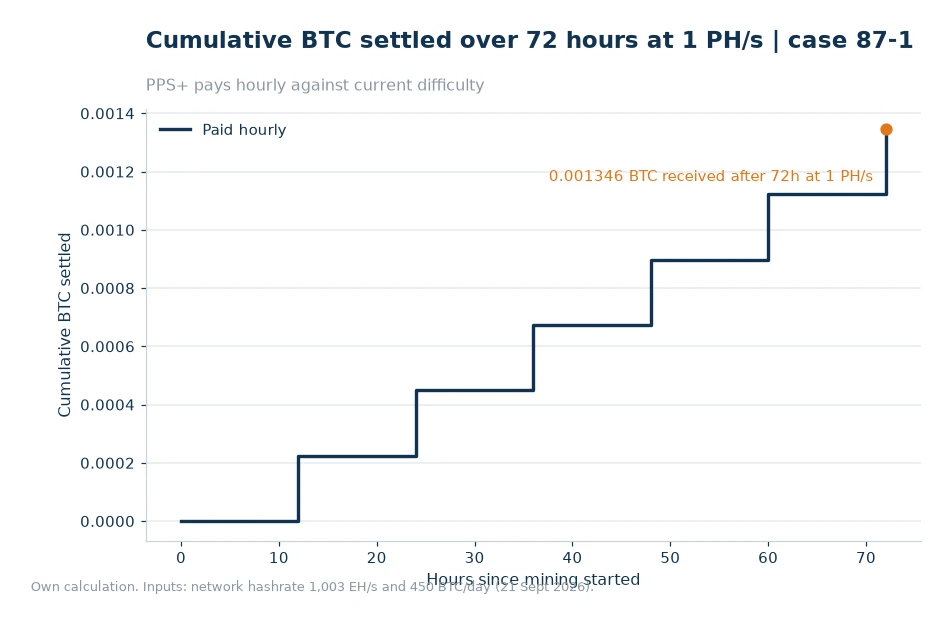
A 1 PH/s setup accrues close to 0.00001869 BTC per hour under PPS+, reaching 0.00134582 BTC after three full days. That is roughly $113.98 at $84,692 per coin. The question for a shed operator is not the meter — it is where the machines should live.

Key takeaways
- Three days at 1 PH/s settle 0.00134582 BTC, about $113.98, posted as 72 equal hourly credits.
- Each 12-hour block adds 0.0002243 BTC ($19.00), so any half-day outage costs a visible slice.
- Hosting changes power, cooling and repair logistics; the per-hour credit formula stays identical.
- The Mining Farms listing plus Miner Hosting and Mining Companies pages map the托管 market from both sides.
Three days, one unchanging hourly rate
The arithmetic behind the chart is deliberately boring: 450 BTC a day divided across 1,003 EH/s of network weight gives 1 PH/s a daily share of 0.00044861 BTC, and each hour posts one twenty-fourth of that, near 0.00001869 BTC. Seventy-two repetitions later the total reads 0.00134582 BTC. Difficulty sat at 132.76 T for this reading, with the next adjustment pencilled near −2.12%, so the staircase is a photograph, not a forecast.
Why watch for 72 hours instead of one? Because three days catch the small frictions a single day hides: a firmware restart overnight, a hot afternoon that throttles one board, a pool of dust in a filter. Each event removes a step or two from the staircase, and over 72 steps the pattern becomes legible. A flat week and a ragged week pay differently even at identical nameplate hashrate.
What the shed really costs you
A home or shed setup pays in ways that never reach the pool ledger: residential power tariffs, summer heat fighting box fans, noise complaints, and your own evenings spent reseating cables. None of that changes the 0.00001869 BTC hourly credit, but all of it eats the dollars around it. Write down the full monthly cost of the shed — power, ventilation, your time valued honestly — before comparing it with anything else.
Uptime is the silent variable. A shed rig at 97% availability surrenders more than two of those 72 hourly credits, about $3.17 per missing hour at the reference price. Over a month that leakage rivals a hosting fee people hesitate over. Measure your real uptime for a fortnight; most home operators are surprised, and not pleasantly.
What a farm slot actually sells
A hosted slot does not buy you more coins per hour — the pool cannot tell a hosted share from a shed share. What it buys is industrial power pricing, engineered airflow, on-site hands, and someone else's 3 a.m. alarm. Listings under ViaBTC Mining Farms collect such offers in one place, while the Miner Hosting and Mining Companies pages describe the providers behind them. Think of it as renting the building around the meter, not upgrading the meter itself. The Miner Hosting directory profiles providers that take third-party machines, complementing the farm listings.
Contracts usually price per machine per month or per kilowatt-hour, sometimes with repair terms and minimum stays attached. Convert any quote to a daily figure and hold it against the daily credit at your scale — $37.99 at 1 PH/s and $84,692 — plus your power number. If the hosted all-in cost beats the shed all-in cost with uptime factored in, the farm wins on paper; if not, the shed keeps its crown for another quarter.
Checkpoints across the three days
The table below slices the 72-hour run into 12-hour blocks, each worth 0.0002243 BTC or about $19.00. After the first block the meter shows $19.00; after three blocks (36 hours) it shows $56.99; after five it shows $94.98; the sixth closes at $113.98. Identical blocks make mental bookkeeping trivial: count the blocks, multiply by nineteen dollars, done.
Use those blocks as an uptime ruler. If your dashboard shows five full blocks and one thin one, the thin block's shortfall in dollars is the price of whatever happened in those twelve hours. Hosted or home, the ruler works the same way, which is precisely why it is useful in a hosting negotiation: both sides can agree on what an outage cost without arguing about methodology.
Power tariffs decide more than pools do
Two sheds with identical machines earn identical BTC and wildly different dollars, because electricity is the only cost line that varies by postcode. At $0.06 per kWh a 1 PH/s fleet near 20 J/TH draws about 20 kW, burning 480 kWh or $28.80 daily against $37.99 of gross — leaving room to breathe. At $0.12 the same fleet burns $57.60 and the exercise turns loss-making before fees even enter. The pool pays for terahashes; the utility decides whether they were worth selling.
Before signing anything, phone your supplier and confirm the all-in delivered rate including demand charges, not the headline generation figure. Then model three tariffs — yours, a 20% higher one, and a hosted quote — against the $19.00 twelve-hour block. Whichever column stays green through a difficulty bump is where the machines belong. Hashrate is portable; contracts often are not.
Keeping score after a move
If you do relocate machines, keep the pool-side account in your own name and compare the first hosted fortnight against your shed baseline block by block. The Profit Calculator translates current difficulty into expected daily dollars for the comparison, so separate luck from logistics cleanly. A genuine improvement shows up as fuller 12-hour blocks, not as a different rate per block.
Also confirm payout plumbing survived the move: same wallet, same thresholds, same zero-fee mining payouts on exit. Hosting changes the building, never the ledger identity. The 72-hour staircase after the move should look like the one before it, only smoother — and if it does not, the contract's uptime clause is suddenly the most interesting paragraph you signed.
| Block | Hours elapsed | Running BTC | Running dollars |
|---|---|---|---|
| First 12 hours | 12 | 0.0002243 | $19.00 |
| Three blocks | 36 | 0.00067291 | $56.99 |
| Five blocks | 60 | 0.00112152 | $94.98 |
| Full run | 72 | 0.00134582 | $113.98 |
Worked example
Trace the full run from first principles. A petahash is 1,000 TH/s, and each TH/s earns 450 ÷ 1,003,000,000 = 0.00000044865 BTC daily, giving 1 PH/s exactly 0.00044861 BTC a day. Each hour posts 0.00044861 ÷ 24 = 0.00001869 BTC. Twelve of those hours make 0.0002243 BTC ($19.00); thirty-six make 0.00067291 BTC ($56.99); sixty make 0.00112152 BTC ($94.98); seventy-two make 0.00134582 BTC, and 0.00134582 × 84,692 = $113.98. Miss any two hours to a tripped breaker and 0.00003738 BTC ($3.17) never appears — the staircase simply ends two steps short.
Frequently asked questions
Does moving to a farm change the hourly credit?
No. The 0.00001869 BTC hourly rate at 1 PH/s follows shares and difficulty, so hosting alters costs and uptime, never the pool formula.
How much is a half-day outage worth?
Twelve missed hours at this scale remove 0.0002243 BTC, about $19.00 at $84,692, which is why uptime dominates hosting math.
Who keeps the pool account in a hosted deal?
You do. The machines, the login, the wallet and the payout address stay yours; the host supplies space, power, cooling and hands.
Audit the shed before you rent the hall
Run your rigs for two weeks, log every missed hour against the 0.00001869 BTC standard, and price your own labor at something honest. That diary is the only fair baseline a hosting quote can be judged against. Without it you are comparing a brochure with a daydream.
Then request two written numbers from any host: the all-in daily cost per PH/s and the remedy when machines sit dark. If the first sits comfortably below your shed's true daily cost and the second has teeth, sign with confidence. If either is vague, the shed — noisy, dusty, yours — remains the rational choice.
Photograph the meter at move-out and move-in: shelf wattage, fan speeds, firmware versions. Those snapshots end arguments about whether a board arrived healthy, and they cost nothing but five minutes with a phone.
Sources: the ViaBTC farms, companies and fee pages for hosting categories and the listed PPS+ terms. Underlying chain figures read 21 Sept 2026: 1,003 EH/s of network weight, 132.76 T difficulty, 3.125 BTC per block, 144 blocks daily, BTC $84,692. Published 24 Oct 2026; every figure here is arithmetic on that snapshot.[1].