Vetting a factory for a solid or oil-based fragrance is not the same exercise as vetting one for a spray. In these formats the base goes on the skin with the scent, so the supplier's ability to build a wax or carrier base that holds the fragrance, survives heat and does not weep over time matters as much as the perfume blend itself. A first-time founder should shortlist on evidence of base development and filling equipment, not on price per unit or the length of a stock scent list. The five questions below are the ones that separate factories that genuinely run these formats from factories that will quietly subcontract the parts they do not own.
Key takeaways
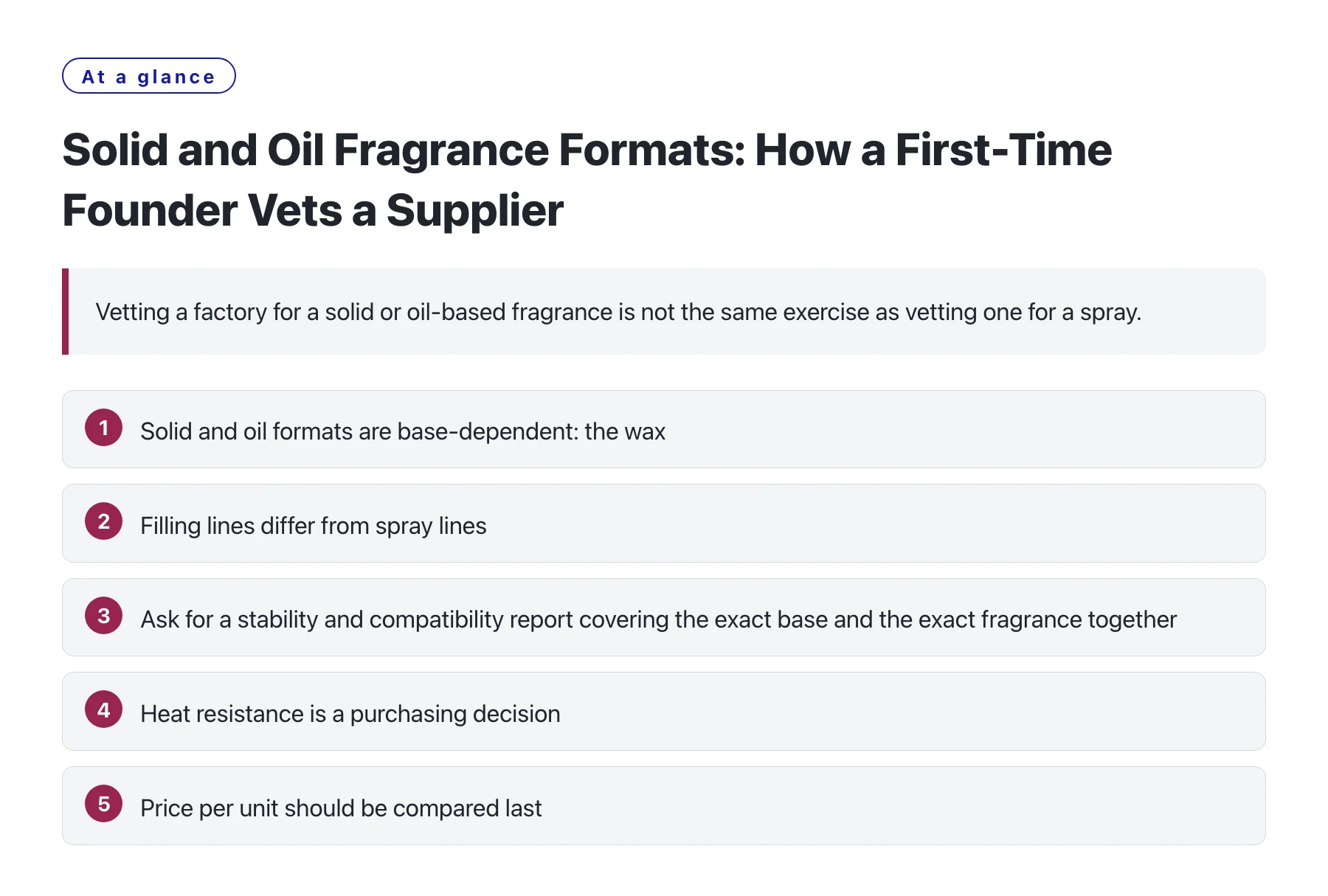
- Solid and oil formats are base-dependent: the wax, butter or carrier oil decides how the fragrance behaves, so ask who develops the base rather than only who blends the scent.
- Filling lines differ from spray lines, with hot-fill and controlled cooling for solids and cold-fill for roll-ons, and a factory without the right line will subcontract the step it does not own.
- Ask for a stability and compatibility report covering the exact base and the exact fragrance together, because a stable base and a stable concentrate can still fail as a pair.
- Heat resistance is a purchasing decision, not a detail: a solid that softens in a summer van will not survive ordinary distribution.
- Price per unit should be compared last, because quotes for these formats are only comparable once the base, fill weight, fragrance load and packaging are fixed in writing.
Most founders begin this search the way they begin a spray search: send the brief to ten factories, compare the unit price, pick the middle one. With solid and oil formats that approach fails early, because the base is a formulation project in its own right.
A spray is a forgiving system. Ethanol carries the fragrance, evaporates, and leaves very little behind. A solid stick or a roll-on has to hold the fragrance inside a matrix that stays on the skin for hours, and every property of that matrix - melting point, oil absorption, glide, colour stability - interacts with the fragrance compound sitting inside it.
This guide is written for a founder placing a first order, with no technical team and no laboratory of their own. It covers the five questions worth asking, the evidence that makes an answer credible, and the checks that reveal a factory is learning the format on your money.
Why the base is a bigger decision than the scent
In a solid format the fragrance is a guest inside a wax and oil structure. That structure sets the drop point, the drag on skin, the surface finish and the rate at which the scent is released. Push the fragrance load up and the stick softens, blooms or weeps oil into the packaging; keep it low and the product smells like a candle left in a drawer.
In an oil format the fragrance is dissolved in a carrier such as a light ester or a plant oil. The carrier decides how quickly the product absorbs, whether it leaves a film, and how long the scent stays on the skin. A carrier that behaves well with a heavy amber can turn cloudy or separate with a bright citrus accord.
Choosing a partner therefore means choosing someone who can hold two formulation problems at once. That is a different skill from compounding a liquid concentrate, and it is worth paying attention to how a supplier talks about it.
It also helps to learn the vocabulary before the first call. Public material databases that describe how individual aroma materials smell and how long they tend to last on skin give a founder enough language to question a base choice without needing a chemistry background [3].
The base and the fragrance have to be tested as a pair
A base that passes its own stability test and a fragrance that passes its own review can still fail together, because the failure mode - solubility, colour drift, viscosity change, oxidation - only appears when the two are combined in the final packaging.
Material restrictions add a second constraint. The IFRA Standards Library sets out how much of a given material may be used in each product category, and a leave-on product with a high fragrance load consumes more of that allowance per gram than a dilute one does [1]. That is a formulation task for the supplier, not a certificate you can request after the fact.
Why the question of who develops the base matters
Ask directly whether the factory develops its wax, butter or carrier base in house, and whether it can show the development record. Plenty of factories buy a ready base from a third party and add fragrance, which is legitimate work, but it limits what they can change when your brief calls for a different skin feel or a firmer stick.
The follow-up question is harder: has the factory tested that bought-in base against your fragrance, in your packaging, at your fill weight? A supplier that answers all three parts without hesitating controls more of your project than one that answers only the first.
Five questions that produce usable answers
| Question to ask | What a strong answer contains | What a vague answer sounds like |
|---|---|---|
| Who formulates the base, and how many base variants can you build? | A named development record, at least two base options built for different skin feels, and samples of both. | We can make any format you want. |
| How is the fragrance load set, and what happens at the top of the range? | A tested range tied to drop point and skin feel, with a stated consequence when the load goes too high. | We always use the strongest possible load. |
| How do you test heat and transport before shipping? | A stated condition and duration, a recorded result, and a corrective action taken when a sample failed. | Our products never melt. |
| Which filling line runs this format, and what do you subcontract? | A description of hot-fill, cooling, plugging or rollerball insertion equipment, plus a named list of outsourced steps. | We have a very big factory. |
| What did the last base change cost a client? | An example of a change request, the weeks it added, and how the client was informed. | Changes are always easy. |
The value of these questions is not the answers alone but the consistency of the answers across suppliers. When three factories describe the same base development step differently, the differences are the useful part.
What to inspect on the line
A solid format is usually filled hot. The base is melted, the fragrance is added at a controlled temperature, and the mixture is dosed into sticks, pans or tins and then cooled on a controlled profile. If the fragrance is added too hot, the top notes burn off; if the cooling is uneven, the surface cracks or shows sink marks. Ask what temperature the fragrance is added at and how the cooling profile is controlled, and expect a specific answer rather than a general assurance.
In an oil format the filling is usually cold and the components matter more than the temperature. Rollerball housings have to be inserted to a consistent depth, the ball has to rotate freely, and the closure has to seal against leakage in transit. Leak testing and torque checks belong in the production record, not in a verbal promise.
Line inspection should also cover the boring parts: fill weight checked at a stated interval, a visual standard for surface defects, and retained samples pulled from each batch. A manufacturer that presents itself as a full fragrance production partner should be comfortable letting you watch those checks on a video call, because they happen on every run rather than only on yours Xuelei OEM/ODM.
An anhydrous product carries little or no water, so the microbiological risk is lower than in an emulsion. The exception is a pan or balm that the user applies with a finger, where the surface can be contaminated after opening. Ask how a factory reasons about preservative-free claims and what it does to protect the product surface, and be suspicious of a supplier that has never considered the question.
Label wording is another place where the base becomes visible to the buyer. Carrier oils, waxes and butters are declared under ingredient names rather than trade names, and the EU ingredient database is the reference most formulators work from when they build that list [2]. Checking that the supplier can name its base ingredients properly is a quick, low-cost test of how well documented the formula really is.
Ask for a compatibility sample, not just a fragrance sample. The sample that matters is the finished product in its final packaging, held at room temperature and at an elevated temperature for long enough that separation, weeping or a colour shift would have appeared. If a supplier only sends scented wax in a plain tin, you have not yet seen the product you are buying.
How to run the first comparison
Once the answers are in, score them. Mark each factory for base development, filling capability, testing discipline and responsiveness, and treat price as a tie-breaker rather than a first filter. The scoring sheet matters less than the discipline of asking every supplier the same five questions in the same order, because inconsistency is what makes quotes look comparable when they are not.
A factory that advertises one-stop fragrance manufacturing should be able to show base development, compounding, filling and testing under the same roof; if those four steps sit with four different vendors, you are coordinating a supply chain rather than buying a product one-stop fragrance manufacturing. That is a legitimate way to work, but it changes who is responsible when something drifts between the sample and the bulk.
Public project write-ups are useful for the same reason. Reading a set of examples of fragrance projects tells you which formats a supplier has actually shipped and at roughly what scale, and whether the work looks like yours or like a different category altogether examples of fragrance projects.
The evaluation ends with a technical conversation, not a price list. A manufacturer that builds custom scents will normally want to know the skin feel you are after, the climate the product will be sold in, and the fill weight before it quotes; a supplier that quotes in one line from a photograph is quoting an assumption a manufacturer that builds custom scents.
Sources
- IFRA Standards Library (International Fragrance Association) —— The IFRA Standards Library lists the restrictions the fragrance industry applies to individual fragrance ingredients, based on safety assessments; it is the reference point for compliant fragrance formulation.
- EU CosIng — Cosmetic Ingredient Database (European Commission) —— The European Commission's CosIng database of cosmetic ingredients, listing ingredient functions, restrictions and labelling requirements under EU cosmetics law.
- The Good Scents Company —— A reference database of aroma materials with odour descriptions, CAS numbers and typical usage information.
Frequently asked questions
Can a factory that already makes my spray version also make a solid or roll-on version?
Often yes, but only if it has base development capability and the matching filling line. If either is missing, the work will be subcontracted, and the responsibility for the finished product can end up split between two suppliers. Ask which steps happen on site before you assume the same factory will run both formats.
How many base variants should I test before choosing a supplier?
At least two, ideally three, built to different skin feels or firmness levels. Testing a single base tells you whether the product is acceptable; testing several tells you whether the supplier can adapt when your brief changes, which is the capability you are really buying.
Is a higher fragrance load always better in a solid or oil format?
No. In a solid, a higher load softens the stick and increases the chance of weeping, bloom or packaging staining. In an oil it can make the product feel heavy or leave a film. The material restrictions that apply to a leave-on product also consume more allowance as the load rises, so the ceiling is often set by the formula rather than by preference.
What single sample should a first-time founder insist on?
The finished product in its final packaging, produced on the same base and fragrance load you intend to order, and held at an elevated temperature as well as room temperature. A fragrance blotter or a plain scented disc proves nothing about base performance, heat behaviour or packaging compatibility.
Should base development be a separate line on the quote?
It can be, and it is worth asking either way. What matters commercially is whether the cost is amortised into the unit price, who owns the base formula once it is developed, and what happens to that formula if you move the project to another supplier later. Settle those three points before you treat the number as final.