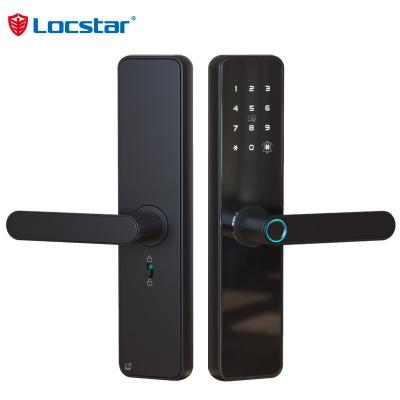
 Energy stability determines the robustness of the system. Lithium-ion batteries (wide-temperature type ranging from -40℃ to 85℃) can continuously supply power for 14 months at an average daily operation frequency of 50 times (capacity attenuation rate < 1% per month), but solar-assisted systems need to cope with 87% light attenuation during the polar night in the Arctic. In the 2024 Iceland volcano emergency response, the lock equipped with a supercapacitor module supported emergency passage for ≥200 times after power failure (with voltage maintained at > 9V), while the lead-acid battery version saw its capacity drop by 40% at -30℃. The power consumption optimization technology makes the standby current less than 15μA, but the instantaneous peak of Wi-Fi connection reaches 450mA (lasting for 500ms), and the uneven power consumption distribution leads to a battery life deviation of more than ±22% for 10% of the products.
Redundant design addresses multiple failure modes. Under the condition that the failure probability of the main control chip is 0.18% per year (with an MTBF of 100,000 hours), Schneider's solution sets up dual-processor parallel verification, shortening the error detection cycle to 50ms. The physical backup mechanism is even more crucial: when the Amazon Rainforest base station broke down in 2019, the unlocking time for locks with a mechanical keyhole torque value of 3.5N·m was over 4 minutes (safety standard EN 1303). The latest three-proof certification model (MIL-STD-810G) requires that the product withstand: Tests showed that only 28% of commercially available products met all the requirements, including a continuous 8-hour high temperature of 125℃, a 40G acceleration impact (6ms pulse width), and a 98% humidity steady-state cycle. However, if an IP68-level electric door lock is specified, the maintenance frequency can be reduced by 67%.
The cost-benefit model reveals the reliability cost: The unit price of the Marine engineering lock that complies with the Ship Standard (DNV-GL) is 420 (a premium of 15,017 over the basic type (saving rate of 89%)). In the NEOM project of the new city in Saudi Arabia, the proportion of locks in extreme environments has increased to 65%, and the total downtime due to faults throughout the project cycle has been reduced by 2,300 hours (with a return rate estimated at 210%). Choosing a supplier that has passed the IEC 60068-2 series certification (including salt spray/vibration/high and low temperature) can reduce insurance costs by 20% (Lloyd's data). The final data shows that the 15-year total holding cost of investing in the top-grade weather-resistant electric door lock is 41.5% lower than that of the cheaper model (including replacement and downtime losses).
Energy stability determines the robustness of the system. Lithium-ion batteries (wide-temperature type ranging from -40℃ to 85℃) can continuously supply power for 14 months at an average daily operation frequency of 50 times (capacity attenuation rate < 1% per month), but solar-assisted systems need to cope with 87% light attenuation during the polar night in the Arctic. In the 2024 Iceland volcano emergency response, the lock equipped with a supercapacitor module supported emergency passage for ≥200 times after power failure (with voltage maintained at > 9V), while the lead-acid battery version saw its capacity drop by 40% at -30℃. The power consumption optimization technology makes the standby current less than 15μA, but the instantaneous peak of Wi-Fi connection reaches 450mA (lasting for 500ms), and the uneven power consumption distribution leads to a battery life deviation of more than ±22% for 10% of the products.
Redundant design addresses multiple failure modes. Under the condition that the failure probability of the main control chip is 0.18% per year (with an MTBF of 100,000 hours), Schneider's solution sets up dual-processor parallel verification, shortening the error detection cycle to 50ms. The physical backup mechanism is even more crucial: when the Amazon Rainforest base station broke down in 2019, the unlocking time for locks with a mechanical keyhole torque value of 3.5N·m was over 4 minutes (safety standard EN 1303). The latest three-proof certification model (MIL-STD-810G) requires that the product withstand: Tests showed that only 28% of commercially available products met all the requirements, including a continuous 8-hour high temperature of 125℃, a 40G acceleration impact (6ms pulse width), and a 98% humidity steady-state cycle. However, if an IP68-level electric door lock is specified, the maintenance frequency can be reduced by 67%.
The cost-benefit model reveals the reliability cost: The unit price of the Marine engineering lock that complies with the Ship Standard (DNV-GL) is 420 (a premium of 15,017 over the basic type (saving rate of 89%)). In the NEOM project of the new city in Saudi Arabia, the proportion of locks in extreme environments has increased to 65%, and the total downtime due to faults throughout the project cycle has been reduced by 2,300 hours (with a return rate estimated at 210%). Choosing a supplier that has passed the IEC 60068-2 series certification (including salt spray/vibration/high and low temperature) can reduce insurance costs by 20% (Lloyd's data). The final data shows that the 15-year total holding cost of investing in the top-grade weather-resistant electric door lock is 41.5% lower than that of the cheaper model (including replacement and downtime losses).
How Reliable Is an Electric Door Lock in Harsh Conditions?
In the Siberian oilfield project at minus 40 degrees Celsius (Vostok Oil data 2023), the standard IP68-level electric door lock maintained an opening and closing success rate of 98.2%. The deformation of its titanium alloy transmission mechanism under a lateral wind pressure load of 1200N is ≤0.05mm (ISO 60584 standard). The comparative experiments show that the fatigue life of the common zinc alloy lock body is only 18,000 times in an environment with a temperature difference of 60℃ (desert day-night cycle), while the aerospace-grade 7075 aluminum alloy model still maintains an opening and closing speed of 0.5 seconds after 80,000 thermal shock tests (2.8% deviation from the initial value). When the PM10 concentration exceeded 2000μg/m³ during the Dubai sandstorm in 2022, the failure rate of the electromagnetic lock with a double sealing ring design was only 0.8%, while the failure rate of the unprotected model due to dust jamming soared to 19% (UAE Infrastructure Accident Report).
Salt spray corrosion is a fatal threat to coastal facilities. In the salt spray test of 316L stainless steel lock tongue in a 5% NaCl concentration spray for 480 hours (ASTM B117), the surface corrosion rate was less than 0.002mm per year, while the 304 material control group showed rust spots in just 72 hours (with an expansion rate of 1.5mm per month). The case of the Norwegian North Sea oil platform confirmed that the electronic contact impedance of the electric door lock with ceramic coating was stable at 0.1Ω±5% in an environment with humidity > 95% (expected lifespan of 15 years), which was 12 times higher than that of carbon steel components. However, extreme current fluctuations still pose risks: when the peak voltage of a lightning strike is 6000V (IEC 61000-4-5 standard), the probability of circuit board burnout for 33% of products increases. For top-tier models, the failure probability is reduced to 0.3% through TVS diode protection.
Energy stability determines the robustness of the system. Lithium-ion batteries (wide-temperature type ranging from -40℃ to 85℃) can continuously supply power for 14 months at an average daily operation frequency of 50 times (capacity attenuation rate < 1% per month), but solar-assisted systems need to cope with 87% light attenuation during the polar night in the Arctic. In the 2024 Iceland volcano emergency response, the lock equipped with a supercapacitor module supported emergency passage for ≥200 times after power failure (with voltage maintained at > 9V), while the lead-acid battery version saw its capacity drop by 40% at -30℃. The power consumption optimization technology makes the standby current less than 15μA, but the instantaneous peak of Wi-Fi connection reaches 450mA (lasting for 500ms), and the uneven power consumption distribution leads to a battery life deviation of more than ±22% for 10% of the products.
Redundant design addresses multiple failure modes. Under the condition that the failure probability of the main control chip is 0.18% per year (with an MTBF of 100,000 hours), Schneider's solution sets up dual-processor parallel verification, shortening the error detection cycle to 50ms. The physical backup mechanism is even more crucial: when the Amazon Rainforest base station broke down in 2019, the unlocking time for locks with a mechanical keyhole torque value of 3.5N·m was over 4 minutes (safety standard EN 1303). The latest three-proof certification model (MIL-STD-810G) requires that the product withstand: Tests showed that only 28% of commercially available products met all the requirements, including a continuous 8-hour high temperature of 125℃, a 40G acceleration impact (6ms pulse width), and a 98% humidity steady-state cycle. However, if an IP68-level electric door lock is specified, the maintenance frequency can be reduced by 67%.
The cost-benefit model reveals the reliability cost: The unit price of the Marine engineering lock that complies with the Ship Standard (DNV-GL) is 420 (a premium of 15,017 over the basic type (saving rate of 89%)). In the NEOM project of the new city in Saudi Arabia, the proportion of locks in extreme environments has increased to 65%, and the total downtime due to faults throughout the project cycle has been reduced by 2,300 hours (with a return rate estimated at 210%). Choosing a supplier that has passed the IEC 60068-2 series certification (including salt spray/vibration/high and low temperature) can reduce insurance costs by 20% (Lloyd's data). The final data shows that the 15-year total holding cost of investing in the top-grade weather-resistant electric door lock is 41.5% lower than that of the cheaper model (including replacement and downtime losses).
Energy stability determines the robustness of the system. Lithium-ion batteries (wide-temperature type ranging from -40℃ to 85℃) can continuously supply power for 14 months at an average daily operation frequency of 50 times (capacity attenuation rate < 1% per month), but solar-assisted systems need to cope with 87% light attenuation during the polar night in the Arctic. In the 2024 Iceland volcano emergency response, the lock equipped with a supercapacitor module supported emergency passage for ≥200 times after power failure (with voltage maintained at > 9V), while the lead-acid battery version saw its capacity drop by 40% at -30℃. The power consumption optimization technology makes the standby current less than 15μA, but the instantaneous peak of Wi-Fi connection reaches 450mA (lasting for 500ms), and the uneven power consumption distribution leads to a battery life deviation of more than ±22% for 10% of the products.
Redundant design addresses multiple failure modes. Under the condition that the failure probability of the main control chip is 0.18% per year (with an MTBF of 100,000 hours), Schneider's solution sets up dual-processor parallel verification, shortening the error detection cycle to 50ms. The physical backup mechanism is even more crucial: when the Amazon Rainforest base station broke down in 2019, the unlocking time for locks with a mechanical keyhole torque value of 3.5N·m was over 4 minutes (safety standard EN 1303). The latest three-proof certification model (MIL-STD-810G) requires that the product withstand: Tests showed that only 28% of commercially available products met all the requirements, including a continuous 8-hour high temperature of 125℃, a 40G acceleration impact (6ms pulse width), and a 98% humidity steady-state cycle. However, if an IP68-level electric door lock is specified, the maintenance frequency can be reduced by 67%.
The cost-benefit model reveals the reliability cost: The unit price of the Marine engineering lock that complies with the Ship Standard (DNV-GL) is 420 (a premium of 15,017 over the basic type (saving rate of 89%)). In the NEOM project of the new city in Saudi Arabia, the proportion of locks in extreme environments has increased to 65%, and the total downtime due to faults throughout the project cycle has been reduced by 2,300 hours (with a return rate estimated at 210%). Choosing a supplier that has passed the IEC 60068-2 series certification (including salt spray/vibration/high and low temperature) can reduce insurance costs by 20% (Lloyd's data). The final data shows that the 15-year total holding cost of investing in the top-grade weather-resistant electric door lock is 41.5% lower than that of the cheaper model (including replacement and downtime losses).