Deciding in Two Minutes Whether to Open a Chat
Most of the cost of a bad pick is the time spent on it rather than the click. A two-minute triage pass — counters, one division, and the opening message — is enough to reject most cards on a list, and across twenty candidates it costs about 40 minutes in total.
Key takeaways
- Split the 120 seconds deliberately: 20 on the card, 40 on the ratio, 40 on the opening message, 20 on the decision.
- The ratio is the step that separates cards: 0.029%, 0.015% and 0.026% on the three leading examples.
- Triage is a filter, not a verdict. Register and recall only show themselves once a session is under way.
- Twenty candidates at two minutes each is 40 minutes — worth doing once a week, not before every session.
What two minutes can and cannot cover
Two minutes is enough to answer one question: is this card worth thirty minutes? It is not enough to answer whether you will like the character, because tone and recall are properties of a conversation rather than a card.
The pass works because it is mostly arithmetic. A card scan tells you the tags and who wrote it; the ratio tells you whether the audience keeps it or merely looks at it; the opening message tells you the register and roughly how long the replies will run. Each step can reject a candidate on its own.
Four rules keep the pass quick. Do not read a full card description; do not open a second tab for comparison; do not trip over a card that is merely fine; and do not save anything during triage, because saving is a decision that belongs after a session, not after a first glance.
The ratio step in numbers
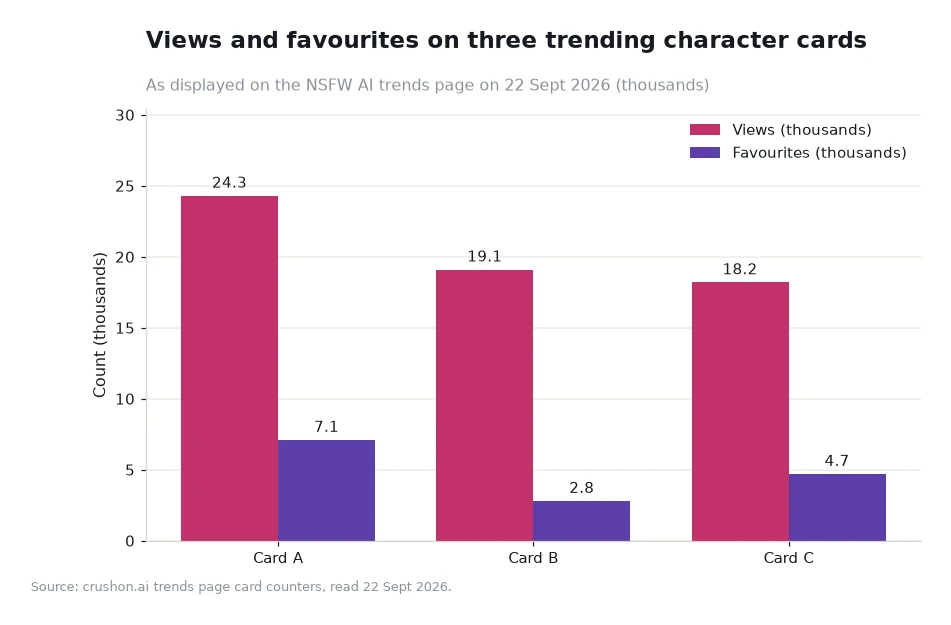
Divide favourites by views and the three leading cards separate cleanly. 7.1K against 24.3M is 0.029%, which is about one deliberate save per 3,400 views. 2.8K against 19.1M is 0.015%, or one per 6,800. 4.7K against 18.2M is 0.026%, or one per 3,900.
The point of doing the division is that the ordering does not do it for you. Reach and keeping are different measures, so a card can sit high on the list and low on the ratio, or the reverse. Two minutes is long enough to run that sum for each candidate on a screen.
Your own baseline is the other half of the method. Average the ratios you are looking at — for these three cards that is 0.070% divided by three, or 0.023% — and treat anything above that line as worth opening and anything well below it as worth skipping this week.
| Step | Time | What you look at | What rejects a candidate |
|---|---|---|---|
| Card scan | 20 seconds | Tag row and creator credit | No tag matches what you actually want today |
| Ratio | 40 seconds | Views and favourites, divided | A ratio clearly below the page baseline of 0.023% |
| Opening message | 40 seconds | Length and register of the first reply | A reply length that fights the way you type |
| Decision | 20 seconds | Two or three survivors at most | Five survivors, which means the filter was too loose |
| Saving | 0 seconds | Nothing yet | Saving during triage rather than after a session |
Worked example: forty minutes, spread over a month
Twenty candidates at two minutes each is 40 minutes, and it does not need to happen in one sitting. Split across 16 sessions in a month — four a week for four weeks — it is 2.5 minutes per session, or about five cards at a time.
Compare that with what it prevents. A single bad pick costs three half-hour auditions before you conclude the fit is wrong, which is 1.5 hours. The triage pass for the whole list costs less than half of one failed audition, and it runs before any chat is opened rather than after.
Put against the month itself the figure is small: 40 minutes is roughly 8% of an eight-hour month built from half-hour sessions, and about 4% of a sixteen-hour month at an hour a session. The heavier the month, the cheaper the pass looks.
Running the pass where the counters are
The pass needs a page that shows both counters at once, which is why it belongs on the platform's porn ai chat board rather than in a search result. The page carries creator credits and tag rows alongside the counters, and its FAQ treats Porn Chat AI and AI Porn Chat as the same category, so there is one vocabulary to learn rather than two.
Crushon's weekly rankings refresh every Thursday, which makes a natural rhythm for the pass: re-run it once a week against the new ordering, keep a note of the baseline ratio, and let the rest of the month run on the survivors.
Two habits make the method stick. Write the baseline down, because it drifts as the pool changes, and keep a parking list for cards that look interesting but do not clear the bar today; a card that clears it next week costs nothing to reconsider later. If a week produces no candidates at all, the character search page is a faster refill than waiting for a new ordering, and the AI chat blog is worth skimming when the rejections start to look like a pattern rather than a run of bad cards.
Keeping the parking list short
A parking list is only useful while it stays small. Ten parked cards is a backlog; four is a queue. The difference is a rule: a parked card expires after two weeks, and if it did not clear the baseline in that time, the problem was not the ratio.
There is a second rule worth applying to the same list. Park the card, not the tag. If every candidate in one group fails the pass, the group is telling you something about how you are reading the tags rather than about the characters, and one session on the best-tagged candidate answers that better than a longer list does.
The list also gives the pass a memory. Without it, the same three cards get triaged every week because they look familiar; with it, the candidates already assessed are visibly done and the two minutes go to cards you have not seen yet.
Frequently asked questions
Can two minutes really rule out a character?
It can rule out a card, which is the useful part. Whether the character itself suits you needs a session, but a weak ratio or a mismatched opening message rarely improves with time.
What should the baseline ratio be?
It depends on the page you are reading. On the three leading cards the average of 0.029%, 0.015% and 0.026% is 0.023%, and that is the figure to compare against.
How often should I run the pass?
Once a week is enough, ideally just after the Thursday refresh, and 40 minutes a month covers twenty candidates at two minutes each.
Make the pass a habit, not a project
Run it once a week, on the fresh ordering, with the baseline written down and the two-minute clock respected. Anything that survives goes on the month's shortlist, and the rest wait without costing you another thought.
Data and sources: the trending card counters and tag data shown on CrushOn.AI[1], read 22 Sept 2026. The two-minute pass, the 40-minute total and the monthly percentages are illustrative assumptions, not platform data. Published for an adult readership of 18 and over.