AD8 Waterproofing: Which Parts of the Cable Qualify
AD8 waterproofing is listed on the manufacturer's pages among the regional requirements its products are built for, next to the CPR fire rating. The site does not publish a clause-by-clause map of AD8 against individual components, so the useful answer comes from the parts that face water and the tests published for them.
Key takeaways
- The site names AD8 waterproofing and CPR as regional requirements, but publishes no component-level table that maps the two.
- Both the insulation and the sheath are electron-beam cross-linked XLPO in low-smoke halogen-free compound, 0.7 mm and 0.8 mm thick on the 1.5 mm² to 10 mm² sizes.
- A water resistance test appears in the manufacturer's published test list, alongside UV, abrasion, cold bending and dimensional checks.
- Finished products are described as 100% inspected for electrical, mechanical and environmental performance under the company's own SIF quality model.
What the pages actually say about AD8
KUKA CABLE presents AD8 as a waterproofing requirement for the regions the company supplies, quoted in the same breath as the CPR fire rating for construction products. Neither rating is expanded into a part list, and no certificate text is reproduced. That matters when a specification asks a supplier to "confirm AD8", because the confirmation has to come from a test report on the finished product rather than from a sentence on a product page. What the pages do carry is the material specification of every layer in the cable and a list of tests the cable has been put through, and those two sets of information are enough to see where the waterproofing work is done. A buyer who needs a component answer should ask for the report by name and check that the sample described in it is the same construction being quoted, which the site sets out layer by layer on its solar pv cable page.
The four places water can enter
A completed run has four points where water can reach a conductor. The first is the outside of the sheath along the whole route, which is why sheath thickness and compound quality carry most of the load; on this family the sheath is 0.8 mm of XLPO on the 1.5 mm² to 10 mm² sizes and rises to 1.7 mm on the largest. The second is the cut end at a termination, where the sheath and insulation stop and the strands are exposed. The third is the mated connector, described on the site as part of a range that includes MC4 and other solar connectors, solar fuse connectors, solar diode connectors and PV cable assemblies. The fourth is the gland or entry where the cable passes into a combiner box or inverter. The published construction says nothing about the third and fourth points beyond naming the parts, so those are the places where a datasheet has to be supplemented with an assembly drawing.
What the test list contributes
The manufacturer publishes a test list that includes water resistance along with UV accelerated weathering, abrasion, cold bending, cold elongation, tensile testing after ageing, solderability, static flexibility and construction and dimensional checks. The 2,000-hour xenon lamp programme, described as equivalent to about 360 weathering cycles with humidity and ozone, is a second route into the same question, because a sheath that has been broken down by light and moisture is a sheath that lets water through. Two production figures support the physical barrier directly: a spark test at 10 kV during manufacture, which is a search for pinholes and thin spots in the insulation, and a test voltage of 6.5 kV AC at 50 Hz applied for five minutes to the finished cable. Neither one is a waterproofing rating, but a pinhole is the shortest path water has. More detail sits on the test page and in the topic notes on the solar cable section.
Temperature limits set the water question too
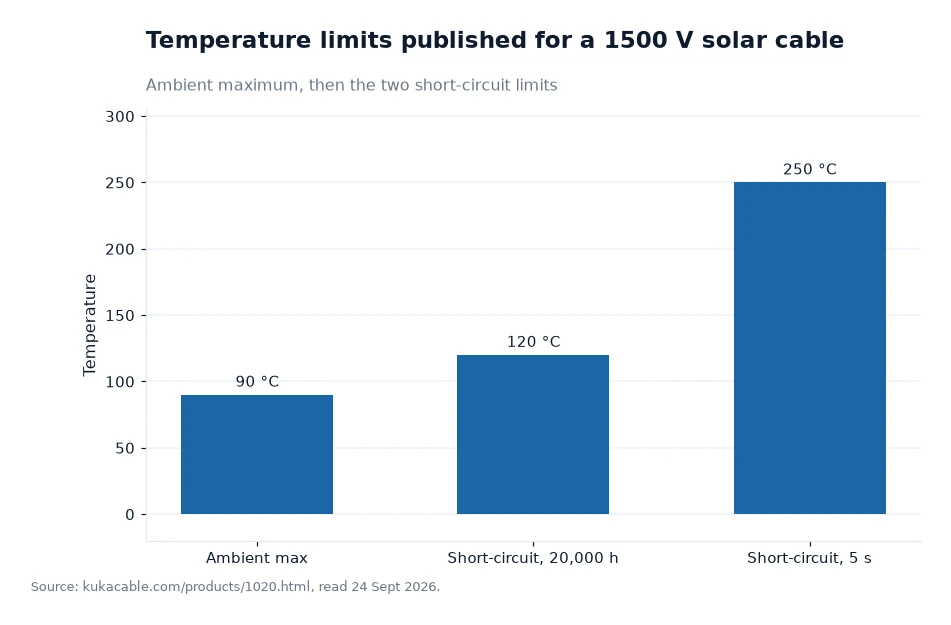
Water and heat act together, and the same product data that answers the water question also answers the heat question. The manufacturer publishes an ambient range of −40 °C to +90 °C for the 1500 V cable, then two short-circuit limits of +120 °C for 20,000 hours and +250 °C for five seconds. A sheath that stays stable at 90 °C for decades is the same sheath that resists hydrolysis when it sits warm and wet; the two properties come from the cross-linked compound, not from a coating. The stated service life is 25 years or more, with one product page giving 30 years for its own model, and the site describes TUV certification as the starting point for that expectation, with certified cables expected to keep electrical safety with low fire risk over that period. The standards quoted for the line are TUV 2PfG 1169/08.2007, EN 50618:2014 and IEC 62930.
| Part of the run | What the site publishes | Water duty it carries |
|---|---|---|
| Outer sheath | XLPO, electron-beam cross-linked, LSHF, 0.8 mm on 1.5 mm² to 10 mm² | Outer barrier along the whole route |
| Insulation | XLPO, electron-beam cross-linked, LSHF, 0.7 mm on the same sizes | Second barrier around the conductor |
| Conductor | Tinned copper, class 5 flexible to IEC 60228 | No barrier; the tin coating limits corrosion if water arrives |
| Connector | MC4 and other solar connectors in the published range | Mated joint and the most exposed point |
| Assembly | PV cable assemblies, fuse and diode connectors | Pre-made joints, each with its own evidence |
Worked example: radius, pinholes and pooled water
A 6 mm² cable in this family has a nominal overall diameter of 6.0 mm, and the published bending radius is four times that, so the smallest permitted bend is about 24 mm (author's calculation: 6.0 × 4 = 24, using the published diameter and the published 4× rule). That figure matters for water because a cable forced into a tighter bend puts the sheath under permanent strain at the outside of the curve, and a strained sheath is where a pinhole is most likely to open up later. The spark test at 10 kV is the manufacturer's check against exactly that kind of defect, run during production rather than on a sample, and the 6.5 kV five-minute test on the finished cable is the follow-up. Neither figure tells a buyer the AD8 result, and neither is published as one; they show what is being watched on the line.
Frequently asked questions
Does the manufacturer state which parts meet AD8?
It does not itemise the parts. AD8 waterproofing is listed among the regional requirements the company builds to, beside the CPR fire rating, but no published table maps AD8 clauses to individual components. The published evidence sits at product level: an XLPO sheath and insulation, a water resistance test in the test list, and 100% inspection of finished products.
Which published test is closest to a water test?
A water resistance test appears in the manufacturer's published test list, which also covers UV accelerated weathering, abrasion, cold bending, cold elongation, tensile testing after ageing, solderability, static flexibility and dimensional checks. The test is named on the site; the site does not publish its duration or pass criteria.
What to request before accepting the claim
Ask for the test report that the AD8 claim rests on, and check that the construction described in it matches the sheath and insulation being quoted, XLPO cross-linked in both layers rather than a PVC equivalent. Ask separately for the connector's own evidence, since the mated joint is not covered by a cable test. Confirm the two production figures on the datasheet, the 10 kV spark test and the 6.5 kV five-minute test, and check the ambient range against the site temperature at the installation. Where the route runs through standing water, ask how the tray is drained and at what spacing the cable is clipped, because the published bending radius of four times the diameter is a minimum for a reason. The site publishes no minimum order, price or lead time, so those questions belong in the commercial thread.
AD8 and the other property names in this piece were taken from the manufacturer's own website, kukacable.com, read closely 24 Sept 2026[1].